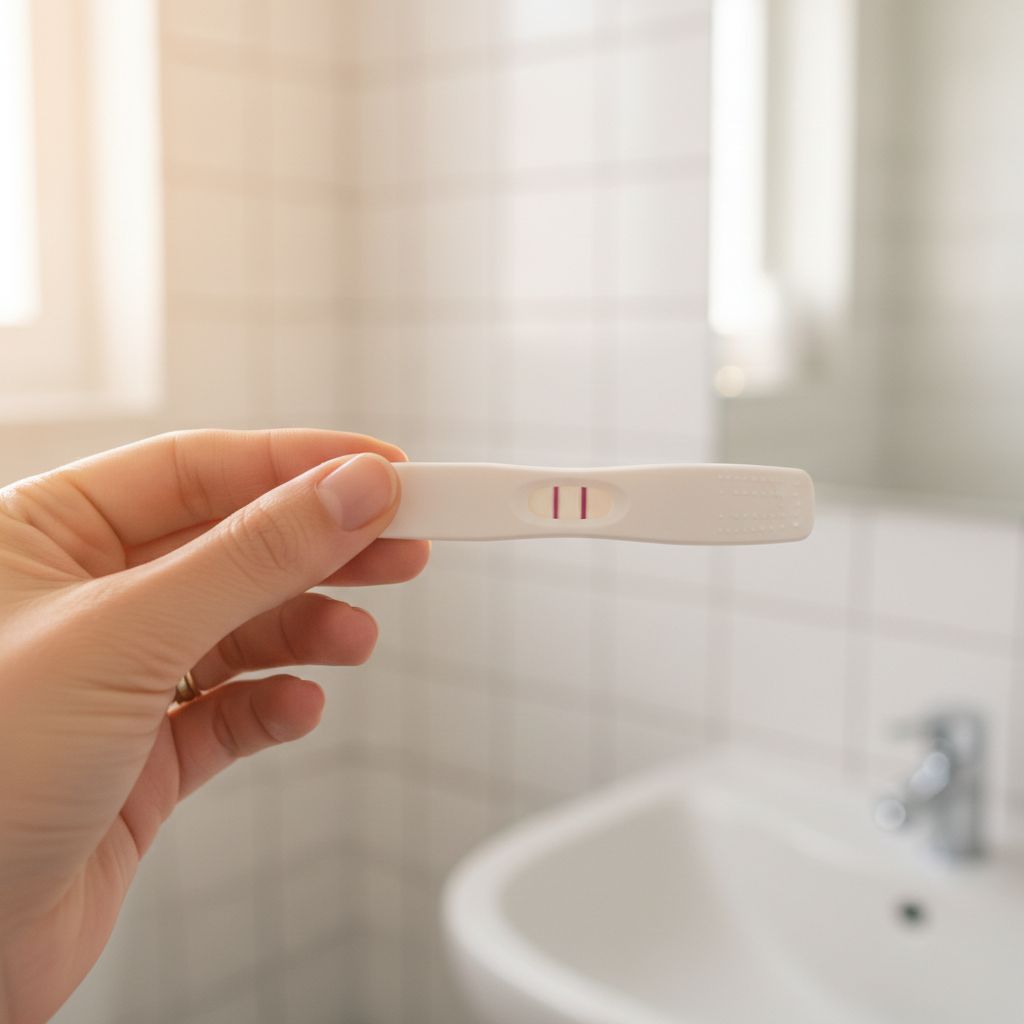
How Does a Pregnancy Test Actually Work?
Home pregnancy tests detect human chorionic gonadotropin (hCG) — a hormone produced by the developing placenta shortly after a fertilized egg implants in the uterine lining. The test uses antibodies that bind specifically to hCG molecules. When enough hCG is present in urine, it triggers a visible color reaction on the test strip.
Most standard home tests detect hCG at a threshold of 20–25 mIU/mL. Some "early result" tests are sensitive down to 6–10 mIU/mL, allowing detection a few days before a missed period.
The hCG Timeline: Why Timing Changes Everything
Understanding hCG doubling is the key to understanding why test timing matters so much.
After implantation (typically 6–12 days after ovulation), hCG levels begin rising rapidly:
| Days Past Ovulation (DPO) | Approximate hCG Range |
|---|---|
| 10 DPO | 5–15 mIU/mL |
| 12 DPO | 10–30 mIU/mL |
| 14 DPO (missed period) | 50–150 mIU/mL |
| 21 DPO | 300–1,000+ mIU/mL |
hCG roughly doubles every 48–72 hours in a healthy early pregnancy. This means a test taken at 10 DPO may show negative even in a confirmed pregnancy — not because you are not pregnant, but because hCG has not yet reached the test's detection threshold.
The practical implication: A negative result before a missed period is not reliable. A positive result at any time is highly reliable.
When Is the Best Time to Take a Pregnancy Test?
For Maximum Accuracy: First Day of Missed Period
Testing on the first day of your missed period (approximately 14 DPO) gives hCG levels time to reach concentrations that all standard tests can detect. At this point, a negative result is meaningful — though not absolute.
For Early Testing: Use First Morning Urine
If you test before your missed period, always use first morning urine (FMU). Overnight, hCG accumulates in urine without dilution from fluids. This can make the difference between a detectable and undetectable result at 10–12 DPO.
Avoid Testing After Heavy Fluid Intake
Drinking large amounts of water before testing dilutes urine and can push hCG concentrations below the test threshold — producing a false negative even when hCG is present.
Understanding Your Results
A Clear Positive
Any visible second line — even a faint one — indicates the presence of hCG and is considered a positive result. The intensity of the line reflects hCG concentration, not pregnancy viability. A faint positive at 10 DPO is just as valid as a dark positive at 14 DPO.
A Clear Negative
One line means hCG was not detected at or above the test threshold. This can mean:
- You are not pregnant
- You are pregnant but hCG has not yet reached detectable levels (too early)
- The test was performed incorrectly
If your period does not arrive within 2–3 days of a negative result, retest.
Faint Lines vs. Evaporation Lines
This is one of the most common sources of confusion:
- Faint positive line: Appears within the test's reading window (typically 3–5 minutes), has color (pink or blue depending on test brand), and indicates hCG presence
- Evaporation line: Appears after the reading window closes, is usually colorless or grayish, and does not indicate pregnancy
Always read results within the manufacturer's specified window. Discard and retest if you are unsure.
Digital Tests vs. Line Tests
Digital tests (which display "Pregnant" or "Not Pregnant") eliminate line interpretation ambiguity but are generally less sensitive than line tests. They typically detect hCG at 25–50 mIU/mL, making them better suited for testing at or after a missed period rather than early testing.
Why False Negatives Happen
False negatives — a negative result in a confirmed pregnancy — are far more common than false positives. Causes include:
1. Testing too early: hCG below detection threshold
2. Diluted urine: Excessive fluid intake before testing
3. Expired test: Degraded antibodies reduce sensitivity
4. Hook effect: Extremely high hCG levels (rare, usually in multiples or molar pregnancy) can paradoxically produce a negative result on some tests
5. Incorrect technique: Not holding test in urine stream long enough, or reading results outside the window
Why False Positives Are Rare But Real
A positive result on a home pregnancy test is almost always accurate. However, false positives can occur in specific circumstances:
- Chemical pregnancy: A very early pregnancy loss after implantation — hCG was produced but the pregnancy did not continue. Technically a real positive that becomes negative
- Recent pregnancy loss or birth: hCG can remain elevated for weeks after a miscarriage or delivery
- Fertility medications: hCG trigger shots (used in IVF and ovulation induction) can produce positive results for up to 14 days after injection
- Certain medical conditions: Rare — some tumors produce hCG (according to the American Cancer Society, this is uncommon but documented)
Blood Tests vs. Home Tests
Your doctor can order two types of blood pregnancy tests:
- Qualitative hCG test: Confirms presence or absence of hCG (similar to home test but more sensitive, detecting as low as 1–2 mIU/mL)
- Quantitative hCG test (beta hCG): Measures the exact hCG level, used to monitor early pregnancy progression and detect potential issues
Blood tests can detect pregnancy earlier than home tests and are not affected by urine dilution.
Tracking Your Cycle for Better Test Timing
Knowing your ovulation date makes test timing far more precise. Our Ovulation Calculator and Fertility Window Calculator can help you identify your fertile window and estimate your DPO — so you know exactly when testing will be most meaningful.
*This content is for educational purposes only and does not constitute medical advice. Always consult your healthcare provider for confirmation of pregnancy and ongoing prenatal care.*
Comments (3)
This article was incredibly helpful! I had no idea about the hCG doubling timeline. Thank you for explaining it so clearly.
This helped me have a much more informed conversation with my midwife. Highly recommend reading this.
The section on warning signs was something I had never seen covered so thoroughly before. Very grateful.